
If you’re building AI agents that need company intelligence (tech stacks, verified emails, decision-makers, or buying signals) you’ve probably hit the same wall everyone else hits: the data layer costs more than the rest of your stack combined.
Apollo prices per seat and spends credits on enrichment. Databar starts at $99/month for 5,000 credits. ZoomInfo prices by demo. People Data Labs bills per record. For an agent processing thousands of companies, the data bill scales faster than the value it creates.
AgentData takes on one part of that bill: which companies to target. It shows every company using your competitors’ products, and the ones that just started, with the evidence for each of 4,000+ technologies, through a REST API and a native MCP server. Single look-ups need no key or account, up to 50 company look-ups a day, and anyone can see the first 25 companies of any customer list. Pro ($99 a month) adds full customer lists for 10 technologies, and Pro and Business both start with a 7-day free trial, no card needed. No credits. It does not replace a contact provider; it tells your agent which companies are worth looking up there.
This post compares AgentData to every major B2B data API used by AI-native teams in 2026, explains exactly what you get, and shows how to connect it to your agent in under two minutes.
Why B2B data APIs break agent workflows
An agent is only as useful as the data it can access. When a sales agent needs to enrich 500 accounts, or a research agent needs tech stacks for a market analysis, or a prospecting agent needs verified emails for outreach, the data API is the bottleneck.
Three things break agent workflows with existing providers:
Credit systems kill batch operations.Apollo’s pricing page says credits are granted at the start of each billing cycle and don’t roll over (apollo.io/pricing, as of 28 October 2026). An agent enriching 500 companies spends credits on every one, and if they run out mid-task there’s no fallback.
Per-seat pricing doesn’t map to agent usage.Apollo, Cognism, and ZoomInfo charge per user per month. An AI agent isn’t a user. A single agent might make 10,000 API calls in a day, but it’s one process running on one server. Per-seat pricing forces you to pay for human access patterns your agent doesn’t use.
Feature gating blocks the best data.Apollo’s pricing page lists API access on its Custom plans (as of 28 October 2026). Apollo filters companies by technology, but does not show the evidence or the date a company started using it, and that is what makes technology data useful for competitive intelligence. Databar has technology data, but at credit-based pricing that scales with every query.
AgentData: what you actually get for free
AgentData is a company intelligence API built specifically for AI agents. Company look-ups, technologies and signals work with no account. An account gives you an API key; Pro adds full customer lists, and Pro and Business both start with a 7-day free trial, no card needed.
Data coverage
- 30 million+ company profiles, with firmographic data: company name, domain, industry sector, business model (B2B/B2C/both), employee estimates, social links, and web signals
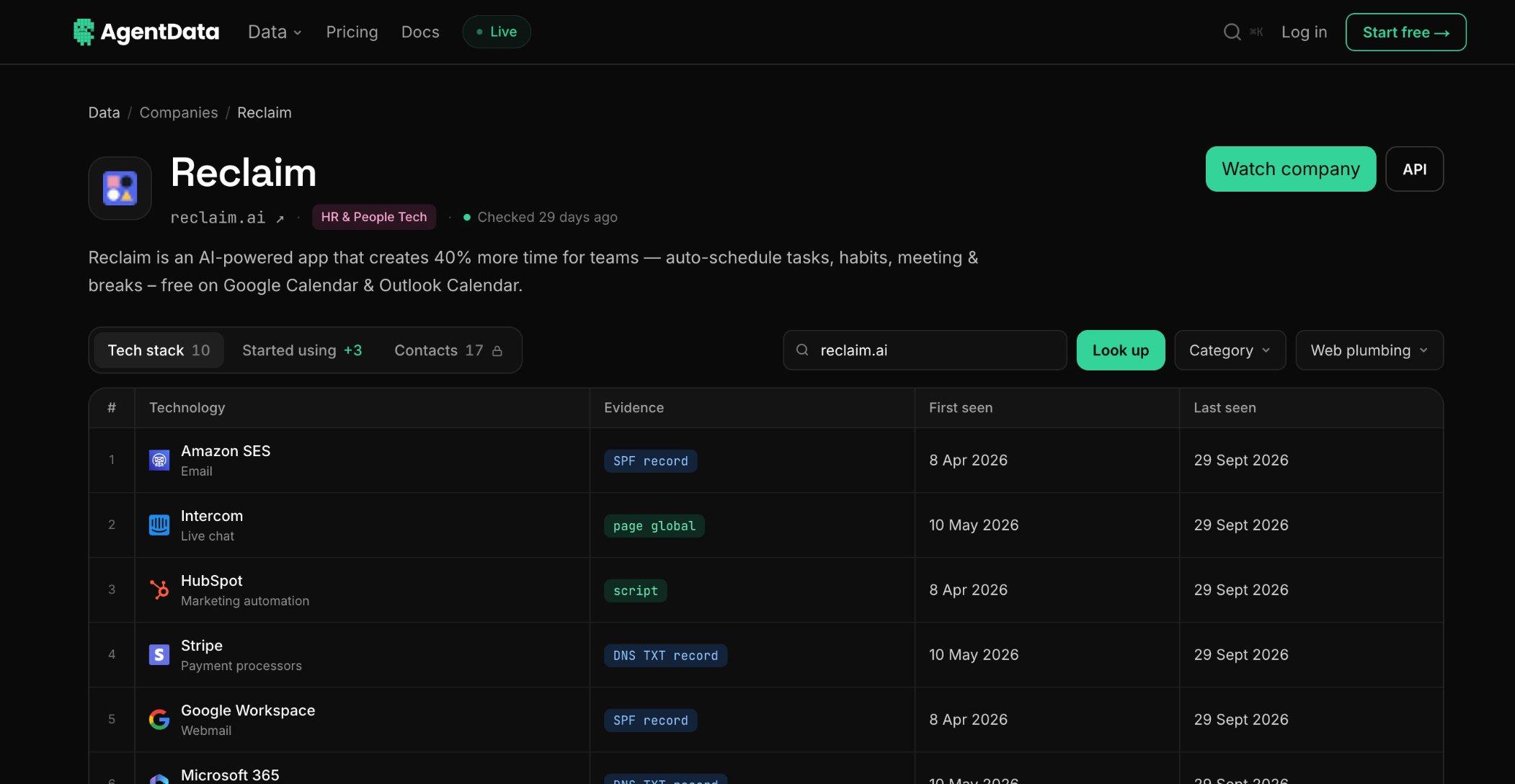
- 4,000+ technologies detected across analytics, live chat, help desk, CRM, marketing automation, CMS, e-commerce, hosting, CDN, and infrastructure categories, found in each site’s page code, response headers and DNS records
- General inboxes and job titles at each company, so your agent knows which roles exist. AgentData is not a contact database: for named people’s details, pair it with a contact provider
- New-customer signals: when a company starts using a tool, for example adds Intercom or Stripe, AgentData records it and exposes it via the signals API. We re-check companies regularly and show the date each tool was last seen
- Web signals: 8 boolean indicators per company: has pricing page, has free trial, has careers page, has API documentation, has blog, has case studies, primary CTA type, and multilingual support
API endpoints
All endpoints return JSON. Authentication via Bearer token (API key generated in account settings).
Every endpoint works on every plan, with no credits and no per-call charges. Pro ($99 a month) raises the daily allowance and adds full customer lists for 10 technologies.
Daily allowance: 50 company look-ups a day without an account, 1,000 on Pro and 5,000 on Business, resetting at midnight UTC. Single look-ups need no key.
MCP server
AgentData has a published MCP server for native AI agent integration. In ChatGPT it’s in the plugin directory: search AgentData under Plugins and choose Install plugin, no sign-in. Install it in Claude Desktop, Claude Code, Cursor, or any MCP-compatible client:
{
  "mcpServers": {
    "agentdata": {
      "command": "npx",
      "args": ["agentdata-mcp-server", "--api-key", "YOUR_API_KEY"]
    }
  }
}
The MCP server exposes seven tools your agent can call natively:
- lookup_company: full company profile by domain
- search_companies: find companies by sector, size, technology, or keyword
- find_people: people at a company, with titles and ids
- get_person: one person by id, with their email
- get_technologies: browse detected technologies or find companies using a specific tool
- get_signals: companies that started using a tool, and career moves
- check_usage: current lookup balance
Your agent doesn’t need HTTP client code, JSON parsing, or auth boilerplate. It describes what it wants in natural language, and the MCP server handles the structured API call.
Example prompt to an MCP-connected agent:
“Find B2B SaaS companies with 50-200 employees that use Intercom, with the evidence for each.”
The agent calls search_companies with the filters and reads the evidence from each result. No code.
Every tool and parameter is listed in the API and MCP documentation. For how this server stacks up against other sales-data MCP servers, see our comparison of 12 MCP servers for sales.
How AgentData compares to every major B2B data API
Competitor facts below come from each vendor’s own pages. Apollo and Hunter were rechecked on 28 October 2026; the others were read in May 2026. For a current side-by-side view, see the data provider comparison page.
 AgentData vs Apollo API
Apollo is the most common starting point for B2B data. Its API is available on paid plans, with the same credit system that governs the web UI.
 AgentData
Apollo’s credits are pooled across the team, granted at the start of each billing cycle and don’t roll over, and its pricing page lists API access on Custom plans (apollo.io/pricing, as of 28 October 2026).
Apollo filters companies by technology, but does not show the evidence or the date a company started using it. AgentData shows both for every technology it detects, and single look-ups cost nothing.
 AgentData vs Databar
Databar is an aggregator: it routes queries across 100+ data providers and has an MCP server. Its plans run from $99 a month (Build, 5,000 credits) to $495 (Scale, 50,000 credits), from databar.ai/pricing on 28 October 2026.
AgentDataDatabar’s strength is breadth: 100+ providers means higher match rates across geographies. AgentData’s strength is depth: first-party data from its own crawlers, and tech stack detection that comes from actually scanning websites rather than buying from a third party, with the evidence shown.
For teams that need both, AgentData works alongside Databar. Use AgentData to choose the companies, by the software they run, and Databar for contact details, phone numbers and intent signals AgentData doesn’t cover.
 AgentData vs ZoomInfo API
ZoomInfo is an enterprise data platform, priced by demo.
AgentDataZoomInfo is built for enterprise sales teams with dedicated RevOps managing the stack. AgentData is built for developers who need company data in their agent and don’t want to negotiate an enterprise contract.
 AgentData vs Hunter API
Hunter is best known for finding and verifying email addresses. Prices below are from hunter.io/pricing as of 28 October 2026.
AgentDataIf you need email addresses, Hunter is excellent, and it pairs well with AgentData: AgentData chooses the companies (who they are, what tools they use and what’s changing), and Hunter finds the people.
 AgentData vs People Data Labs
People Data Labs (PDL) sells a large raw dataset of people and company records through an API.
AgentDataPDL is built for volume and identity resolution. AgentData is built for technology data, with the evidence. For agents that need to identify what technologies a company uses (for competitive intelligence, market research, or targeted prospecting) AgentData’s first-party tech detection is the better fit.
Three agent workflows you can build today
1. Competitive intelligence agent
Prompt:“Which companies started using Intercom in the last 30 days? Get me the Head of Customer Support at each one.”
How it works with AgentData MCP:
- Agent calls
get_signalswithmoved_to: "intercom"anddays: 30 - Returns the companies that added Intercom, and when we first saw it
- Agent calls
find_peoplefor each company, filtering for customer support leadership - Returns named contacts with email addresses (and their verification status), titles and seniority
Cost on AgentData: Free. On Apollo:Apollo filters by technology, but does not show the evidence or the date a company started using it, so the new customers can’t be picked out. Cost on Databar: Credits per signal lookup + credits per people enrichment.
2. Market sizing agent
Prompt:“How many B2B SaaS companies use Intercom? Break down by sector and country.”
How it works:
- Agent calls
get_technologieswithslug: "intercom" - Returns company count and paginated list
- Agent calls
search_companieswith technology filter to segment by sector and country
Cost on AgentData: Free. On Apollo: Apollo filters by technology, but does not show the evidence or the date a company started using it. Cost on ZoomInfo: Credits, on pricing set by demo.
3. Lead enrichment agent
Prompt:“Enrich this list of 200 company domains with tech stacks, email addresses for decision-makers, and web signals.”
How it works:
- Agent loops through domains, calling
lookup_companyfor each - Each call returns full profile: tech stack, emails, people, signals
- Agent structures output as CSV or pushes to CRM
Cost on AgentData: 200 lookups (20% of daily budget). Free. Cost on Apollo: 200+ credits. Cost on Databar: 200+ credits ($99/month minimum plan).
Getting started in under two minutes
Option 1: MCP server (for Claude, Cursor, or any MCP client)
1. Start a 7-day free trial at agentdata.run/signup (no card needed)
2. Go to Settings → generate an API key
3. Add to your MCP config:
{
  "mcpServers": {
    "agentdata": {
      "command": "npx",
      "args": ["agentdata-mcp-server", "--api-key", "YOUR_API_KEY"]
    }
  }
}
4. Ask your agent: “Look up stripe.com and tell me their tech stack”
Or use the hosted endpoint (no npx required):
{
  "mcpServers": {
    "agentdata": {
      "transport": "http",
      "url": "https://mcp.agentdata.run/mcp",
      "headers": {
        "Authorization": "Bearer YOUR_API_KEY"
      }
    }
  }
}
Option 2: REST API (for any language or framework)
curl -H "Authorization: Bearer YOUR_API_KEY" \
  "https://agentdata.run/api/v1/lookup?domain=stripe.com"
Returns JSON with company profile, tech stack, emails, people, and signals.
To wire it into an agent framework, here is tested code for LangChain, the Vercel AI SDK and CrewAI.
Option 3: Web (no code needed)
Browse agentdata.run/company/stripe.com. Company pages are public. The first 25 companies of any customer list are free too, with no account.
Why look-ups are free
AgentData is built by the same team behind DragApp (240,000+ users, shared inboxes for Gmail) and HeyHelp (AI email assistant). The crawling infrastructure that powers AgentData already runs to detect competitor signals for these products.
We can offer free look-ups with no account because:
- The infrastructure cost is already covered by the portfolio
- The MCP server creates distribution through AI agents that recommend tools
Pro ($99 a month) adds full customer lists for 10 technologies, 100,000 companies to download a month and a weekly new-customer email. Pro and Business both start with a 7-day free trial, no card needed. No plan has credits. The data is the product.
The bottom line
Many B2B data APIs charge per seat or per credit, and again when your agent uses more than the plan allows. AgentData charges a flat monthly price for full customer lists, and single look-ups cost nothing.
If you’re building AI agents that need company intelligence (tech stacks, verified emails, decision-makers, new-customer signals) start by choosing the right companies, which AgentData lets you do free with no account. Add a contact provider for the people at those companies.
AgentData shows every company using the software you sell against, with the proof for each and the new customers as they start. Look up any company free; Pro is $99 a month for 10 technologies.