
Apollo prices per seat, and the meaningful actions inside it spend credits. Its pricing page says credits are pooled across the team, granted at the start of each billing cycle and don’t roll over, and that admins can cap credit spend per user (apollo.io/pricing, as of 28 October 2026). Enrichment costs credits. Exports cost credits. When they run out mid-cycle, you wait or upgrade.
So the price on the plan is not the whole cost: what you pay grows with every lookup an active team makes.
There is a better place to start: choose the companies first.
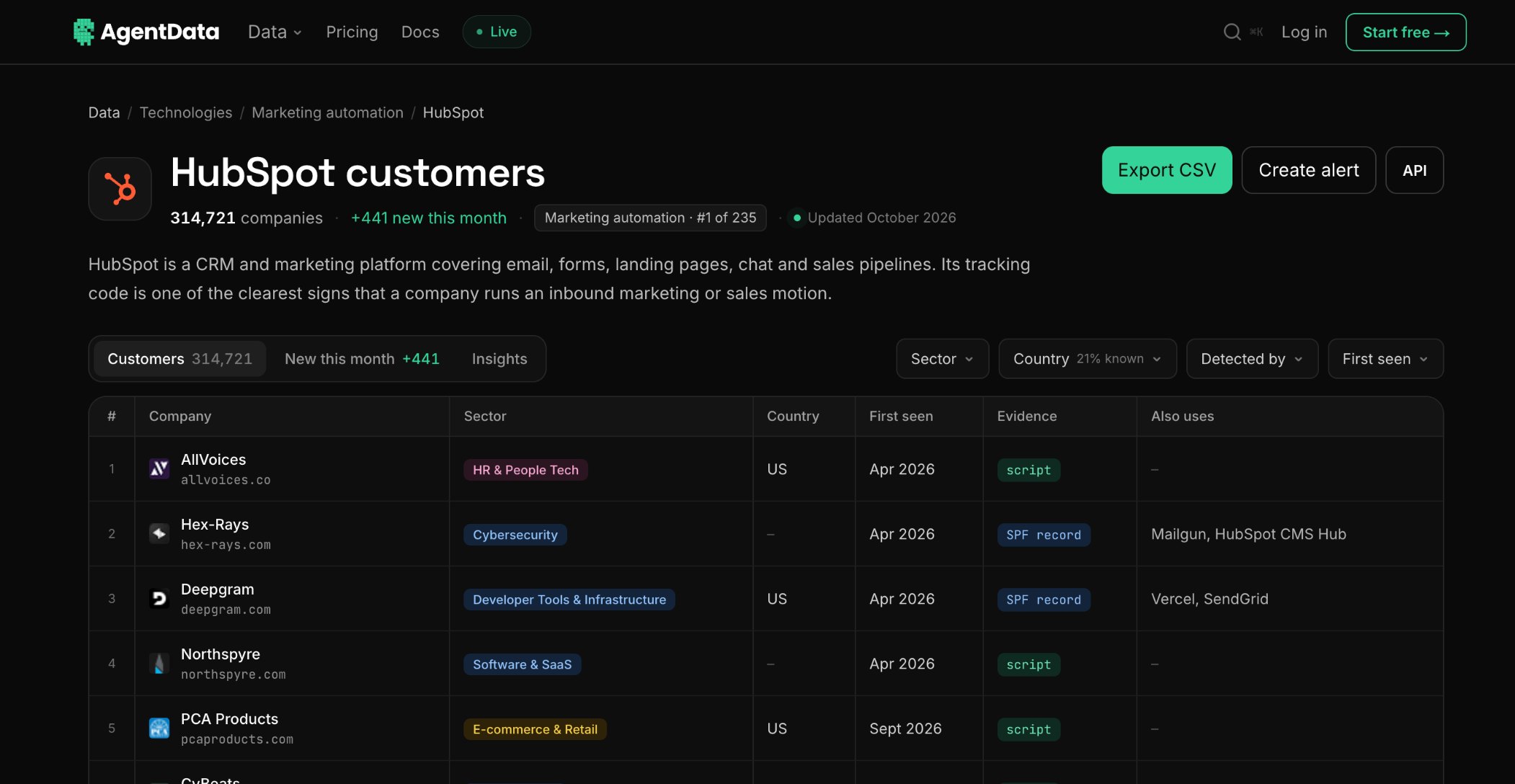
AgentData shows every company using your competitors’ products, and the ones that just started, with the evidence for each tool. With no account you can look up any company and see the first 25 companies of any customer list. Pro, at $99 a month, adds full customer lists for 10 technologies, with a 7-day free trial and no card needed. No credits and no per-contact charges. AgentData does not replace Apollo’s contact data; it tells you which companies to look up in it.
This post breaks down exactly what AgentData gives you that Apollo charges for, what Apollo does that AgentData does not, and how to decide which one fits your workflow.
What Apollo charges for that AgentData gives you free
Apollo gates nearly everything behind credits or paid tiers. Here is what that looks like in practice and what the free equivalent is in AgentData.
Company search and filtering. Apollo lets you search by job title, company size, industry, and location. Revealing contact details and exporting spend credits, and each plan comes with a set number per billing cycle. Once those are gone, you wait or upgrade.
AgentData lets you search company profiles by industry, business model, technology, location and web signals, with no credits. Without an account you get 50 company look-ups a day, and downloading full lists is on Pro ($99 a month).
Contact data. Apollo includes email access on all plans, and this is where it is strong. AgentData is not a contact database and does not try to replace it: use AgentData to choose the companies, then find the people in Apollo.
Tech stack data. Apollo filters by technology, but does not show the evidence or the date a company started using it. You can ask for “companies using Zendesk”, but you can’t see how each one was found or which ones only just started.
AgentData detects 4,000+ technologies across the websites it crawls. You can search for companies by the tools they use, filter by technology category, and see the full tech stack on every company profile, with the evidence for each tool and when it was first seen. This is a core feature, not an add-on.
Web signals. Apollo does not detect whether a company has a pricing page, a free trial, a careers page, a blog, or API documentation. These buying signals are not available in Apollo at any tier.
AgentData detects these signals automatically on every crawled website. “B2B SaaS companies with a careers page and a free trial” is a filter you can run for free. In Apollo, this filter does not exist.
MCP server for AI agents. Apollo has an MCP server with 52 documented actions, and it is the one to pick if you want Claude to build sequences and send email. Free Apollo accounts registered with a personal email can’t use its search and enrichment actions, and enrichment spends credits (Apollo’s MCP docs, read 23 September 2026). Our scored roundup of MCP servers for sales has the detail.
AgentData’s MCP server works with or without an account, and single look-ups need no key. It is purpose-built for AI agent workflows: describe your ICP in natural language, get structured company data back. Install it with one command:
npx agentdata-mcp-serverWhat Apollo does that AgentData does not
This is a fair comparison. Apollo has capabilities that AgentData does not offer, and you should know about them before switching.
Contact volume. Apollo claims 275 million contacts. AgentData is not a contact database. If you need to send 50,000 cold emails to VPs of Sales at companies with 200+ employees, Apollo is the tool for the people; AgentData is the step before, choosing which companies they should work at.
Built-in sequencing. Apollo includes email sequences, a dialer, and campaign management. AgentData is a data platform, not a sending tool. You use AgentData to choose the companies, then find the people and send from your own tools (Instantly, Smartlead, Lemlist, Apollo itself, or any CRM).
Intent data. Apollo offers buying intent signals. AgentData detects web signals (pricing page, careers, free trial) which are intent indicators, but does not have third-party intent data from review sites or ad networks.
CRM integrations. Apollo integrates natively with Salesforce, HubSpot, and other CRMs. AgentData offers its API, CSV downloads on Pro, and CRM integration on Business ($299 a month).
If your workflow depends on Apollo’s sequencing, dialer, or native CRM sync, AgentData is not a drop-in replacement, and it is not meant to be. It is the step before Apollo: AgentData picks the companies, Apollo finds the people.
The real cost comparison
The plan price is only part of it.
Apollo: a per-seat price, plus credits for enrichment, mobile numbers and exports. Before you compare, look at how many credits your team used last cycle and what it cost to get more.
AgentData: a flat monthly price with no credits and no overage charges. With no account you get company look-ups on the website, API and MCP server (50 a day) and the first 25 companies of any customer list. Pro ($99 a month) adds full customer lists for 10 technologies, 100,000 records to download a month and a weekly new-customer email. Pro and Business both start with a 7-day free trial, no card needed.
How to use AgentData with Apollo
If you are currently paying for Apollo and want to test AgentData alongside it, here is the practical workflow.
Step 1: Start a 7-day free trial at agentdata.run. No card needed. Takes 30 seconds.
Step 2: Recreate your Apollo saved search in AgentData.If your Apollo list is “VP of Sales at SaaS companies with 50-200 employees,” the AgentData equivalent is: filter by sector (SaaS), filter by business model (B2B), filter by the software they run. Add web signals for sharper targeting: companies with a careers page (growing), companies with a pricing page (selling a product).
Step 3: Compare the results. Run the same target profile in both tools. Check: how many companies match? Does AgentData show the proof for each one, and which started recently? Does it surface companies Apollo missed (or vice versa)?
Step 4: Take the companies to Apollo. On Pro, download the list as a CSV and find the people at those companies in Apollo. Compare how that campaign does against your usual Apollo searches.
Step 5: Keep what works. If the AgentData list does better, keep using it to choose the companies, and spend your Apollo credits only on the people at those companies. API and MCP access are included on every AgentData plan.
What you get that Apollo does not offer
Technology detection across 4,000+ tools. Search for companies using any specific technology: Zendesk, Shopify, HubSpot, Stripe, Intercom, and thousands more, with the evidence for each and when it was first seen. Apollo filters by technology, but does not show either. Filter your prospect list by the tools your target companies actually use. Build campaigns that reference their tech stack. “I noticed you are running Zendesk” hits differently when they actually are.
Web signals as filters.Find companies with a free trial (product-led growth), a careers page (hiring, has budget), a pricing page (sells something), a blog (marketing-aware), or API docs (technical). These are live signals detected from the company’s website, not static fields from a CRM import three years ago.
AI-classified industries.AgentData crawls each company’s website and uses AI to classify them by sector, business model (B2B, B2C, marketplace), and go-to-market motion. “B2B SaaS” means B2B SaaS, not “Information Technology and Services” from a dropdown someone picked during signup in 2019.
Natural language prospecting via MCP.Install the AgentData MCP server. Ask Claude: “Find me 200 B2B SaaS companies in the UK with a pricing page, and a careers page.” Claude returns a structured list. No clicking, no filtering, no exporting. Describe your ICP, get a list.
Freshness you can see. We re-check companies regularly and show the date each tool was last seen, so you can tell how current every detection is before you use it.
Who should stay on Apollo
AgentData is not the right choice for everyone currently on Apollo. Stay on Apollo if:
You need the built-in dialer.Apollo’s dialer with call recording and transcription is integrated. AgentData does not have a dialer. If phone outreach is your primary channel, you need Apollo or a separate dialer.
You need 50,000+ contacts per campaign.Apollo’s database is larger in raw contact volume. If your campaigns are high-volume, low-targeting (spray and pray), Apollo’s scale matters. If your campaigns are precision-targeted (find companies using a specific tool in a specific industry), use AgentData to choose the companies and Apollo for the people.
You rely on native CRM sync.If your workflow depends on Apollo pushing contacts directly into Salesforce or HubSpot, note that AgentData’s CRM integration is on Business ($299 a month); on Pro you import a CSV.
Your company pays for Apollo and you do not control the budget. If Apollo is a company-wide tool managed by RevOps, switching is a procurement decision, not an individual one. But you can still use AgentData free with no account alongside Apollo for comparison data, and for the technology evidence and start dates that Apollo does not show.
Get started
- Start a 7-day free trial at agentdata.run. No card needed.
- Search for companies by industry, location, or technology at agentdata.run/companies.
- Filter by web signals: careers page, pricing page, free trial, blog.
- Download the list as a CSV on Pro, and find the people in Apollo or your contact tool.
- Or install the MCP server (
npx agentdata-mcp-server) and build lists in Claude with natural language.
You are paying Apollo for contact data. AgentData tells you which companies to spend it on: who uses a competitor’s product, with the proof, and who just started. Free to look up.
See how we compare on the Apollo alternative landing page, or read the API documentation and pricing.
AgentData shows every company using the software you sell against, with the proof for each and the new customers as they start. Look up any company free; Pro is $99 a month for 10 technologies.